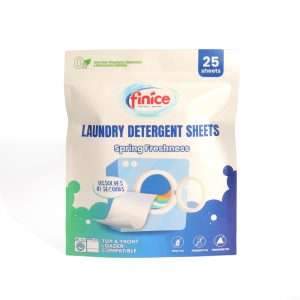
Cold water laundry sheets should be evaluated in a washing machine under clearly recorded conditions, not approved only because a sheet disappears in a glass of water. For private label brands, importers and retail buyers, a useful sample trial separates three questions: does the sheet disperse, does it remove the target soils, and does the finished wash leave acceptable fabric and machine conditions?
Cold-water washing remains relevant to energy-conscious product development. The American Cleaning Institute’s Cold Water Saves initiative encourages suitable cold-water laundry practices. That makes a specific testing brief more useful than an unsupported “works in cold water” promise. The checklist below is a practical procurement framework, not a certification method or a report of Finice test results.

1. Define what cold water means for your customers
A washer’s cold setting is not a complete test specification. Record the actual water temperature, machine model, program, wash duration and load mass. Select conditions that reflect the market where the product will be sold, including a realistic lower-temperature condition where relevant.
Agree on the test plan with the supplier or laboratory before comparing samples. If one supplier demonstrates a sheet in warm water with vigorous stirring and another tests a full load on a short cold cycle, the results cannot support a fair comparison.
2. Use a written sample-testing matrix
Start with your intended label directions. Use the recommended dose for each product, then document the dose in both sheets and grams. A one-sheet comparison is misleading when sheet mass and formulation differ.
| Test factor | What to record | Why buyers need it |
|---|---|---|
| Water conditions | Measured temperature and water hardness, with units | Makes results relevant to the destination market |
| Machine and program | Model, load capacity, cycle and wash duration | Prevents unlike wash conditions being treated as equivalent |
| Load | Dry load mass, fabric types and loading method | Improves repeatability between sample trials |
| Product | Sample code, batch, age, sheet mass and recommended dose | Connects the result to an identifiable formulation |
| Application | Sheet placement and any pre-treatment | Tests the directions the customer will actually follow |
| Assessment | Stain results, residue observations and repeat runs | Separates cleaning performance from appearance or fragrance |
For an initial screen, choose a normal intended-use condition and a more demanding but realistic condition. A larger validation program can follow once the sample passes this first stage. The buyer, supplier and laboratory should agree on the number of repeats and acceptance limits; there is no universal pass score implied by this checklist.
3. Assess dissolution and cleaning separately
Check dispersion in the intended wash
A water-container demonstration can help screen samples, but it does not reproduce a loaded drum. Follow the proposed pack instructions and inspect the completed wash for visible sheet fragments or deposits, especially in fabric folds and accessible parts of the drum. Record when and where any residue appears rather than simply marking a sample “good” or “bad.”
Compare stain removal against a defined benchmark
Use the same selected soils and fabrics for each trial. A professional laboratory can help select standardized stained swatches and an appropriate measurement method. Include a relevant commercial benchmark at its recommended dose under matching machine, load and water conditions.
The American Cleaning Institute explains that cleaning combines chemical action, mechanical action, temperature and time. For buyers, the practical implication is to control these factors during comparison. A longer cycle or a different dose may change the result even when the sheet itself has not changed.
Do not substitute foam volume, fragrance intensity or a single before-and-after photograph for a documented stain-removal assessment. Photos can support the record when lighting and camera settings are consistent, but they should not be the only evidence for a performance claim.
4. Check residue after rinsing and drying
Inspect suitable light and dark test fabrics after the full cycle, and again after the chosen drying method. Record visible marks, fragments and unusual feel. Keep drying conditions consistent when comparing samples. If a problem appears, repeat the trial while changing one factor at a time, such as dose or sheet placement, to identify the cause.
Check that any proposed instructions remain convenient for the customer. A sample that performs acceptably only with an undisclosed extra rinse or additional preparation should not be presented as a simple, direct replacement without explaining those requirements.
5. Include packaged samples, not just fresh loose sheets
The sample used for approval should represent the product and packaging you intend to order. Ask for batch identification and storage instructions. Agree with the supplier on an appropriate storage and transport evaluation, then repeat the relevant wash checks on conditioned samples.
Record changes such as sticking, tearing, fragrance change or packaging damage if they occur. Do not turn a short storage trial into an unsupported shelf-life claim. Packaging qualification and shelf-life substantiation need their own agreed methods and evidence.
6. Turn test findings into a clear acceptance decision
Before placing an order, create a short approval record that includes:
- The approved sample and formulation reference, with batch identification.
- The market, intended wash conditions and final dosage directions.
- The agreed performance criteria and the evidence supporting them.
- Any failed conditions and how the supplier resolved them.
- The approved packaging specification and required documentation.
- The process for reviewing formula, material or packaging changes.
Avoid averaging away a meaningful failure. If a sample passes the standard wash but repeatedly leaves residue in a relevant cold program, address that condition before approving a broad claim. Keep the comparison data with the purchase specification so that later production checks have a usable reference.
After validating the recommended dose, compare the commercial proposal using our guide to calculating the landed cost of laundry detergent sheets. This helps connect an approved wash dose with a realistic procurement decision.
Questions to include in your sample request
Send a concise brief rather than asking only for your supplier’s “best sheet.” You can adapt this request:
We are evaluating private label laundry sheets for [country and sales channel]. Our intended machine type is [type], the target wash temperature is [range], and the intended load is [mass and fabrics]. Please recommend a sample and dosage, identify the formulation and batch, and provide available test methods and results relevant to these conditions. Please also confirm packaging options and the information needed to agree on an acceptance test.
Finice offers laundry detergent sheet manufacturing and private label customization. To discuss samples for your market, contact the Finice team with your target country, sales channel, packaging format and testing brief. Request evidence for the specific formulation and conditions you plan to promote.
Frequently asked questions
Does fast dissolution prove good cold-water cleaning?
No. Dispersion and soil removal answer different questions. Evaluate both in controlled, repeatable wash trials.
Should every supplier be tested at one sheet per load?
Use each product’s proposed label dose for a consumer-use comparison, and record the mass and cost of that dose. Equal sheet counts do not necessarily mean equal amounts of detergent.
Can a successful cold-water trial support every washing claim?
No. Keep claims within the conditions and outcomes actually evaluated. A routine cleaning trial does not by itself establish disinfection, skin compatibility, biodegradability or performance in every machine.