Laundry detergent sheets are becoming a more visible format for modern retail, e-commerce and private-label cleaning ranges. For distributors and importers, the opportunity is not simply to add another eco-friendly SKU. The stronger strategy is to build a portfolio that matches channel demand, delivers reliable wash performance, supports efficient logistics and gives retailers enough margin to keep the product on shelf.

Recent industry reporting points to continued interest in compact, pre-measured and sustainability-oriented laundry formats, while B2B sourcing guidance increasingly emphasizes MOQ, lead time, documentation and supplier consistency. That means distributors should evaluate the category as a complete business system rather than a single product purchase.
1. Start With the Channel You Want to Win
A distributor serving supermarkets will have different requirements from an importer focused on Amazon, specialty eco stores, hotels or regional grocery chains. Before requesting samples, define the first channel and its commercial expectations.
| Channel | Typical priorities | Recommended starting range |
|---|---|---|
| Supermarkets | Shelf appeal, retail margin, stable supply, clear claims | Core everyday formula plus fragrance-free or premium option |
| E-commerce | Compact shipping, review-worthy performance, bundle potential | Trial pack, family pack and subscription-friendly refill |
| Eco and lifestyle stores | Ingredient transparency, packaging story, sustainability positioning | Low-plastic pack with carefully documented claims |
| Hospitality and serviced apartments | Simple dosing, storage efficiency, dependable replenishment | Bulk pack or individually portioned commercial format |
Do not launch too many SKUs at the start. A focused range is easier to forecast, easier to explain to buyers and less likely to create slow-moving inventory.
2. Build a Portfolio Around Use Cases
The most practical portfolio usually combines one high-volume core product with two or three differentiated products. The core SKU should be easy to understand and competitively priced. Differentiated SKUs can target fragrance, sensitive skin, premium care or travel convenience.
A balanced distributor portfolio may include:
- Everyday fresh or clean fragrance formula
- Fragrance-free or sensitive-skin positioning
- Premium long-lasting fragrance variant
- Travel or compact trial pack
- Private-label refill or value pack for repeat buyers
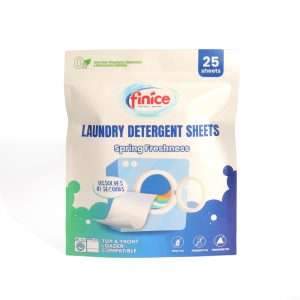
Finice offers laundry detergent sheets and related laundry-care products that can support a broader category strategy instead of a one-product launch. Distributors can also cross-sell fabric softener sheets, color-absorbing sheets and fragrance enhancers to increase basket value.
3. Evaluate the Product on B2B Performance Criteria
Retail buyers may notice the package first, but repeat orders depend on product performance. Sample testing should cover the conditions that matter in the destination market and the channel where the product will be sold.
- Cleaning performance on representative household stains
- Cold- and warm-water dissolution
- Residue after washing
- Recommended dosage and load size
- Fragrance strength and retention, where relevant
- Batch consistency and storage stability
- Compatibility with common washing machines
Ask the supplier to explain the test method, not only the result. A buyer should be able to compare samples on the same basis. Finice can discuss formula direction, active content, stability and solubility during product development, but the final commercial decision should be based on documentation for the selected SKU.
4. Understand Cost Per Load, Not Just Unit Price
One of the most common sourcing mistakes is comparing a box price without calculating the actual cost per wash. A lower factory price may still produce a weaker retail proposition if the sheet count, dosage or packaging format is less efficient.
Use this simple model:
Cost per load = landed product cost ÷ number of recommended washes
Then add the costs that affect your real margin:
- Packaging and artwork setup
- Inspection and testing
- Freight, insurance and import charges
- Warehouse handling
- Marketplace or retailer fees
- Promotional discounts and damaged stock
A distributor should compare at least three scenarios: entry price, target price and premium price. This makes it easier to see whether a product can serve different channels without damaging the brand architecture.
5. Review MOQ and Lead Time as a Planning System
MOQ is not only a factory rule. It affects cash flow, SKU count, launch timing and inventory risk. Ask whether the MOQ applies to the formula, sheet quantity, printed packaging, carton artwork or the full production run. These may be different.
For a first launch, consider using a standard formula with customized packaging before investing in multiple custom formulas. Once sell-through is proven, you can introduce additional scents, pack sizes or specialized formulas.
Also confirm:
- Sample lead time and approval process
- Production lead time after artwork approval
- Peak-season capacity planning
- Reorder lead time
- Safety stock recommendation
- Change-control procedure for formula or packaging updates
6. Check Packaging and Claim Discipline
Packaging has to work for retail, e-commerce and export handling. Buyers should review pack durability, moisture protection, carton strength, barcode placement, language requirements and storage instructions.
Claims such as biodegradable, plastic-free, plant-based, hypoallergenic or non-toxic should be used only when they are accurate and supportable for the specific product and market. The European Chemicals Agency explains that detergent products placed on the EU market are subject to labeling and ingredient-related requirements, while the U.S. EPA Safer Choice program provides a separate framework for qualifying safer chemical products. These are not interchangeable standards, so your supplier must clarify which documents and evaluations apply to your destination market.
7. Score the Supplier Before You Scale
| Evaluation area | Questions to ask |
|---|---|
| Formula | Can the supplier provide stable specifications and explain customization limits? |
| Quality | How are raw materials, in-process checks and finished goods controlled? |
| Compliance | Which SDS, ingredient, test and labeling documents are available? |
| Production | What are the realistic MOQ, capacity and reorder lead times? |
| Packaging | Can the supplier support retail-ready, e-commerce and export packaging? |
| Communication | Is there one accountable contact for samples, approvals and corrective actions? |
A supplier that answers clearly before the order is usually easier to manage after the order. Request a written quotation and a documented sample approval process so commercial and technical expectations remain aligned.
8. Create a Retail Launch Plan
Distributors should prepare more than a product catalog. Build a launch package that helps buyers sell the category:
- Product specification sheet
- Retail-ready product photos
- Usage and dosage instructions
- Ingredient and compliance document list
- Recommended wholesale tiers
- Merchandising and cross-sell suggestions
- Reorder timeline and contact process
For e-commerce, provide comparison charts, clear pack-count information and a realistic explanation of what the product is designed to do. For supermarkets, focus on shelf communication, price-per-load logic and reliable replenishment.
FAQ for Distributors
Are laundry detergent sheets suitable for private label?
Yes. Private-label programs can customize packaging, fragrance direction, pack count and selected formula features, subject to the manufacturer’s technical and compliance limits.
Should a new distributor launch one SKU or several?
Start with a focused range that covers a clear core need and one or two differentiators. Expand after sales data confirms demand.
What documents should buyers request?
Typical requests may include product specifications, SDS, ingredient information, test reports, packaging details and destination-market labeling support. The exact list depends on the country and claims.
How can distributors reduce inventory risk?
Use conservative SKU planning, confirm reorder lead times, negotiate realistic MOQs and validate sell-through with a core formula before adding many variants.
Conclusion
A profitable laundry detergent sheets portfolio depends on more than a low quotation. Distributors need the right channel strategy, a focused SKU architecture, verified wash performance, disciplined claims, workable MOQs and a supplier that can support repeat orders. The best time to solve these issues is before artwork approval and production, not after the first shipment arrives.
If you are sourcing laundry detergent sheets for wholesale, private label or retail distribution, contact Finice to discuss product formats, packaging options, OEM/ODM development and export requirements.