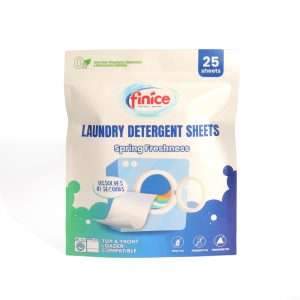
For private label laundry detergent sheets brands, packaging is no longer only a design and cost decision. Retail buyers, importers and distributors increasingly expect packaging data, product documentation and environmental claims to be aligned before a new SKU is launched. This is especially important for brands selling into the European market, where detergent and packaging rules are evolving on separate but connected timelines.

This guide explains how B2B buyers can build a practical compliance-ready workflow for private label laundry detergent sheets. The goal is not to replace market-specific legal advice. Instead, it gives procurement teams a structured way to evaluate suppliers, packaging formats, technical files and launch claims before products reach retail shelves.
Why packaging readiness matters for private label laundry detergent sheets
A detergent sheet product usually combines a concentrated cleaning formula, a primary pack, secondary packaging, transport cartons and a set of on-pack claims. If any one of these elements changes late in development, the result can be delayed artwork, relabelling costs, missed retailer deadlines or a mismatch between the product sold and the documentation available.
Packaging readiness also affects brand credibility. Claims such as “plastic-free,” “biodegradable,” “plant-based,” “water-soluble” or “low-waste” need to be supported by the right evidence and expressed carefully for the destination market. Buyers should therefore treat packaging, formulation and compliance as one product-development project rather than three separate tasks.
Key 2026 developments B2B buyers should monitor
1. New EU detergents rules create a longer-term data requirement
In 2026, the European Union published Regulation (EU) 2026/405 on detergents and surfactants. Industry guidance explains that the regulation replaces the earlier framework and is intended to apply from 23 September 2029, with new requirements around digital information, ingredient transparency and product data. For private label brands, the practical lesson is to start collecting structured product information now instead of waiting until the final compliance deadline.
For each SKU, buyers should ask whether the manufacturer can provide a controlled data set covering the product identifier, manufacturer details, country of production, ingredients, fragrance and preservative information, hazard classification where applicable, biodegradability information and dosage instructions. The exact legal obligations depend on the market and the product classification, so the final review should be completed with qualified regulatory support.
2. EU packaging rules are becoming more operational
The EU Packaging and Packaging Waste Regulation is another important development for brands selling into Europe. Guidance published in 2026 highlights that the regulation began applying progressively from 12 August 2026, with packaging design, documentation and sustainability obligations being phased in over time. This means buyers should examine material choices, recyclability, unnecessary empty space, labelling and supplier data during product development.
For laundry detergent sheets, packaging decisions can include paperboard cartons, flexible pouches, refill formats, inner moisture barriers, shipping cartons and protective inserts. A pack that looks sustainable but cannot be documented or separated correctly at end of life may create future compliance or retailer-review problems.
Build a compliance-ready product file before approving artwork
Before a private label laundry detergent sheets product moves to final artwork, create a product file that links the formula, pack and market claims. A practical file can include:
- Final product specification and intended use
- Ingredient information and fragrance details
- Recommended dosage and usage instructions
- Performance and stability test records relevant to the product
- Packaging material specification and component breakdown
- Country-specific labelling checklist
- Safety and transport documents where applicable
- Evidence supporting environmental or performance claims
- Approved artwork version and change-control record
- Supplier contacts, batch coding and traceability information
This file should be version-controlled. If the formula, fragrance, sheet weight, coating, adhesive, carton board or pack size changes, the buyer should know whether the artwork and technical documents also need to change.
Questions to ask a laundry detergent sheets OEM supplier
Formula and performance
- What is the recommended dosage per wash and how is it shown on pack?
- How is dissolution evaluated in cold and warm water?
- What stability information is available for the finished sheet and packaged product?
- Can the supplier support fragrance-free, sensitive-skin or other market-specific variants?
- How are production batches compared with approved samples?
Packaging and materials
- What materials are used in each packaging component?
- Is the pack designed to protect the sheets from moisture during storage and shipping?
- Can the supplier provide a packaging specification and component weights?
- What options are available for paperboard, refill, pouch or other formats?
- Can the packaging artwork be adapted for different countries and languages?
Documentation and change control
- Which technical and safety documents are available before mass production?
- How are formula or packaging changes communicated?
- Can the supplier support retailer questionnaires and private label compliance reviews?
- How are lot numbers, production dates and traceability handled?
- Which claims can be supported with current evidence, and which claims should be avoided?
How to review environmental claims without increasing risk
Environmental positioning can help a private label laundry detergent sheets brand stand out, but vague or absolute wording can create avoidable risk. Buyers should separate measurable product attributes from broad marketing language.
| Claim area | Buyer evidence to request | Practical review point |
|---|---|---|
| Biodegradability | Relevant test method, scope and product coverage | Confirm the evidence applies to the actual finished product or stated ingredient |
| Water solubility | Test conditions and dosage information | Avoid implying that every component disappears under every condition |
| Plastic reduction | Material comparison and pack specification | Define what is being compared and whether secondary packaging is included |
| Recyclability | Material composition and destination-market guidance | Check local collection and sorting realities, not only the material name |
| Plant-based content | Ingredient or material sourcing evidence | State clearly whether the claim applies to the formula, packaging or both |
For private label products, the safest workflow is to write the claim only after the supplier has supplied the supporting information and the destination market has been reviewed. A strong OEM partner should help buyers understand the limits of each claim instead of encouraging exaggerated wording.
Packaging design priorities for detergent sheets
Packaging for laundry detergent sheets has a specific technical challenge: the product is lightweight and compact, but it is sensitive to moisture. A package that looks attractive in a mock-up may still fail if the barrier performance is not suitable for warehousing, ocean freight or humid retail environments.
Procurement teams should review:
- Moisture protection and sealing performance
- Ease of opening and reclosing
- Sheet count and load-count communication
- Clear dosage instructions
- Language and market-specific mandatory information
- Outer-carton strength for export logistics
- Barcode placement and retail scan performance
- Material minimisation without weakening protection
Packaging should also support the commercial model. A supermarket may need shelf-ready cartons and efficient case packing. An e-commerce brand may prioritise low-dimensional-weight packaging and drop resistance. A distributor may want master cartons with clear SKU coding and pallet efficiency.
A practical supplier scorecard for B2B buyers
To compare suppliers consistently, score each candidate across five areas:
- Product performance: cleaning efficacy, dissolution, scent profile and batch consistency.
- Compliance support: technical documents, market-specific labelling assistance and change control.
- Packaging capability: material options, moisture protection, artwork support and export packaging.
- Commercial fit: MOQ, lead time, sample speed, payment terms and replenishment capacity.
- Communication quality: response speed, transparency and willingness to explain limitations.
A supplier that offers the lowest unit price may not offer the lowest total launch cost. Reworked artwork, failed samples, relabelling, delayed shipments and retailer rejection can quickly outweigh a small quotation difference.
How Finice can support private label development
Finice works with B2B buyers looking for laundry detergent sheets, private label development and export-oriented household cleaning products. Depending on the project, buyers can discuss product positioning, fragrance direction, packaging format, OEM or ODM requirements, documentation and production planning.
To evaluate the product range, visit the laundry detergent sheets manufacturer page and review the broader Finice household cleaning product portfolio. For a structured quotation, prepare the target market, intended retail channel, load count, packaging concept, forecast volume and required claims.
FAQ
Should packaging compliance be reviewed before formula approval?
Yes. Formula, dosage, claims and pack space are connected. Reviewing packaging only after the formula is final can force expensive artwork changes.
Do all private label brands need the same documents?
No. The required documents depend on the destination market, product classification, sales channel, claims and retailer requirements. Buyers should request a market-specific checklist.
Is paper packaging automatically the safest sustainability option?
Not automatically. The full pack structure, barrier layers, inks, adhesives, recyclability guidance and end-of-life system should all be considered.
How early should a buyer involve the OEM supplier?
As early as possible—ideally during product positioning and packaging concept development. Early supplier input can prevent incompatible claims, materials or production assumptions.
Conclusion
Private label laundry detergent sheets brands that plan for packaging and compliance early can reduce launch risk and build stronger retailer relationships. The most effective approach is to connect formula performance, packaging materials, documentation, claims and change control in one product file.
If you are sourcing laundry detergent sheets for a supermarket, distributor, cleaning brand or e-commerce business, contact Finice to discuss OEM, ODM and private label options. Share your target market and packaging concept so the project can be evaluated against real commercial and technical requirements.