Laundry detergent sheets are moving from a niche alternative into a more established laundry-care format. For supermarket chains, wholesalers, distributors and private-label brands, the opportunity is not simply to buy the cheapest sheet. The real procurement question is how to build a product that performs consistently, fits the target market, works with the retailer’s packaging and price architecture, and can be supplied reliably at scale.

Current industry research continues to point to demand for compact, pre-measured and sustainability-oriented laundry formats. Market reports also highlight private label, e-commerce, supermarkets and other retail channels as important routes to market. For B2B buyers, this makes supplier evaluation and product validation increasingly important. Research and Markets notes trends including compact logistics, pre-measured dosing and innovation in enzymes and surfactants, while other 2026 market research identifies North America as a leading region for laundry detergent sheets.
1. Start With the Retail Positioning, Not the Factory Price
Before requesting quotations, define what the SKU is supposed to achieve. A supermarket buyer may be looking for an entry-level everyday detergent, a premium fragrance-led product, a sensitive-skin formula, an eco-positioned range or a private-label alternative to liquid detergent.
These positions require different specifications. A premium SKU may justify upgraded fragrance development, stronger packaging and additional performance testing. A value SKU may prioritize cost per wash, efficient packaging and simplified customization. A sensitive-skin product may require a fragrance-free direction and a more detailed review of ingredients, allergens and supporting documentation.
Write down the target retail price, number of loads, fragrance direction, packaging format, market, machine compatibility and key product claims before comparing factories. This prevents suppliers from quoting different products and makes the RFQ much easier to evaluate.
2. Evaluate Cleaning Performance and Dissolution
For laundry detergent sheets, cleaning performance should remain the core purchasing criterion. Eco-friendly packaging or compact logistics cannot compensate for a product that leaves stains, residue or an unsatisfactory laundry experience.
Ask a manufacturer to provide representative samples and define the test protocol before making a decision. Useful areas to evaluate include:
- Stain removal on common household soils
- Performance in cold and warm water
- Dissolution and residue after the wash
- Cleaning performance at the recommended dosage
- Fragrance retention and sensory performance where fragrance is part of the proposition
- Stability during storage and transportation
- Consistency between sample batches and production batches
Finice states that its laundry sheet testing program can cover cleaning efficacy, active content, foam strength, pH, stability and solubility. Buyers should still request the actual test reports applicable to their chosen formula rather than relying on general supplier statements.
For more detail on Finice’s laundry sheet manufacturing capabilities, see Laundry Detergent Sheets Manufacturer.
3. Compare the Formula, Not Just the Product Appearance
Two laundry sheets can look almost identical while having very different formulation strategies. Buyers should ask what type of surfactant system, enzymes, fragrance system and other functional ingredients are used, and how the formula is adapted to the intended market.
For international B2B sourcing, documentation matters as much as the ingredient list. Depending on the destination market and product claims, buyers may need SDS, technical information, ingredient disclosure, test reports, allergen information or other regulatory documentation.
Do not assume that a formula approved for one market automatically satisfies every market. A supplier should be able to explain what documentation is available and what additional testing may be required for the destination country.
4. Check Water Solubility and Sheet Consistency
Water solubility is a practical quality-control issue. A sheet needs to dissolve appropriately under the intended washing conditions while maintaining its physical integrity during storage and handling.
Ask suppliers to test the actual production specification rather than a generic sample. Important questions include:
- Does the sheet dissolve in cold-water cycles?
- Does it leave visible residue?
- How consistent is sheet thickness?
- Are active ingredients distributed evenly throughout the sheet?
- Does humidity affect sheet texture or packaging stability?
- How is finished-product consistency checked during production?
These questions are especially important for supermarkets and distributors because a quality problem can affect an entire SKU rather than one individual order.
5. Treat Packaging as Part of the Product
For retail buyers, packaging is not simply a printing job. It affects shelf presentation, protection, shipping efficiency, consumer understanding and the final cost structure.
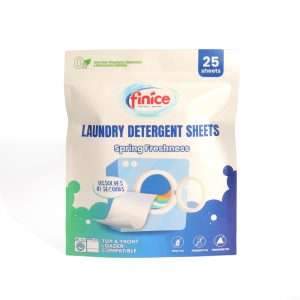
Common private-label formats include paper boxes, pouches and other compact retail packs. The right choice depends on your target market, shelf requirements, branding strategy and sustainability claims.
During supplier evaluation, confirm:
- Minimum packaging order quantities
- Available box and pouch sizes
- Artwork and dieline requirements
- Barcode and labeling requirements
- Packaging material specifications
- Carton dimensions and units per carton
- Protection against humidity during storage and shipping
A good supplier should help the buyer connect the packaging decision with production and logistics instead of treating each part as a separate project.
6. Calculate Total Landed Cost
Comparing factory quotations on a per-box basis can be misleading. The better calculation is total landed cost per retail unit and, where appropriate, cost per wash.
A practical B2B calculation is:
Total landed cost = product cost + packaging + inspection/testing + inland logistics + freight + duties/taxes + other destination costs.
Then compare that number against your planned wholesale price and retail price.
A supplier with a slightly higher ex-factory quotation may still be more competitive if the product has better concentration, more efficient packaging, lower damage rates, better carton utilization or smoother logistics. Conversely, an unusually low quotation should trigger questions about formula specifications, packaging, documentation and quality-control scope.
7. Understand MOQ and Production Lead Time Together
MOQ should not be evaluated in isolation. A lower MOQ can be useful for a market test, but a higher MOQ may provide better unit economics for a proven SKU. The right quantity depends on your sales forecast, number of SKUs, packaging commitments and replenishment cycle.
Ask suppliers to quote at several volume levels instead of requesting only one MOQ. For example, compare a pilot quantity, a first commercial order and a larger repeat-order volume. This gives the purchasing team a clearer picture of how pricing changes as the business scales.
Finice’s current product pages show that OEM/private-label MOQs vary by product and that customized laundry sheet orders commonly involve production lead times of several weeks. Always confirm the MOQ and lead time for the exact formula, packaging and destination market you are buying.
See the Eco-Friendly Biodegradable Laundry Detergent Sheet and Active Enzyme Laundry Detergent Sheets pages for examples of current product specifications.
8. Verify Factory Capability and Quality Control
A supplier’s sales presentation does not tell you enough about its ability to support a retail program. Ask about factory ownership or production structure, quality-control procedures, testing capabilities, production capacity, inspection and traceability.
Finice describes two production facilities, OEM/ODM support, in-house testing and experience supplying international brands. Its website also states that its laboratory can test areas including microbiology, cleaning efficacy, active content, foam strength, pH, optical brighteners, stability and compatibility. These capabilities can be useful when a buyer needs a more controlled product-development process.
For larger retail programs, request a clear quality plan covering incoming materials, in-process checks, finished-product inspection, batch records and complaint handling. A written quality process is more useful than a generic promise of “high quality.”
9. Ask About Export and Compliance Support
International buyers should determine early what documentation the supplier can provide for the destination market. This is particularly important when the product will be sold through major retailers.
Depending on the country and commercial model, buyers may need product specifications, SDS, ingredient information, test reports, packaging information and other compliance documentation. Claims such as biodegradable, compostable, hypoallergenic or plastic-free should be supported by appropriate evidence and should be reviewed for local advertising and labeling requirements.
Finice’s site describes support for global buyers and references certifications and third-party testing. Buyers should request current, product-specific documentation during the sourcing process and verify the validity and scope of any certificate before using it in retail marketing.
10. Build a Supplier Scorecard
For supermarket and distributor procurement, a simple supplier scorecard can make the final decision more objective.
| Evaluation Area | What to Check |
|---|---|
| Cleaning performance | Stain removal, dosage and wash conditions |
| Dissolution | Cold/warm water behavior and residue |
| Formula | Ingredients, fragrance and market suitability |
| Packaging | Materials, artwork, protection and carton efficiency |
| MOQ | Pilot and commercial-order quantities |
| Lead time | Sampling, production and repeat orders |
| Quality system | Testing, inspection and traceability |
| Documentation | SDS, specifications, reports and market compliance |
| Logistics | Export experience, freight planning and delivery support |
| Customization | OEM/ODM formula, scent and packaging flexibility |
Why B2B Buyers Should Test Before Scaling
The best sourcing process is staged. Start with a supplier shortlist, request samples, define the target specification, test the product, review packaging, calculate landed cost and then place a controlled commercial order.
For a private-label program, the sample stage should include more than checking whether the sheet “looks good.” Test actual washing performance, dissolution, scent, packaging protection and the consumer experience. If the product will enter multiple countries, confirm that the formula and claims are appropriate for each destination before printing large quantities of packaging.
This approach reduces the risk of locking a supermarket or distributor into an unsuitable formula or packaging configuration.
FAQ: Sourcing Laundry Detergent Sheets for Retail
What should I ask a laundry detergent sheet manufacturer?
Ask about formula specifications, cleaning performance, dissolution, MOQ, lead time, packaging, testing, quality control, documentation, customization and export experience.
Is a lower MOQ always better?
No. A lower MOQ can reduce launch risk, but the unit cost, packaging cost and production economics may be less favorable. Compare several volume levels before choosing an order size.
Can laundry detergent sheets be private labeled?
Yes. Private-label programs can include customized formulas, fragrances, sheet specifications, packaging and branding, depending on the manufacturer’s capabilities and MOQ.
How can I compare suppliers fairly?
Use the same product specification and test requirements for every supplier. Compare total landed cost, performance, documentation, quality systems and lead time rather than only the factory quotation.
Final Takeaway
For supermarkets, distributors and private-label brands, sourcing laundry detergent sheets in 2026 is a product-development and supply-chain decision, not simply a price negotiation. The strongest supplier should be able to support consistent cleaning performance, reliable dissolution, appropriate packaging, documented quality control, market-specific compliance and scalable production.
Finice provides OEM/ODM and private-label laundry detergent sheet solutions for international buyers, with customizable formulas, packaging and product specifications. If you are evaluating a new laundry sheet SKU, contact Finice for samples, product specifications and an OEM quotation.