For importers, distributors and retail buyers, the supplier quotation is only one part of the real purchasing cost. A laundry detergent sheets program can look attractive at the factory gate and become uncompetitive after packaging, freight, duties, warehousing, compliance work and local delivery are added. Calculating landed cost before approving a supplier helps buyers compare offers fairly, protect margin and choose a product architecture that can scale.

This guide explains the main cost components, the questions to ask an OEM or ODM manufacturer, and a practical framework for comparing private label laundry detergent sheets suppliers without relying on an incomplete unit price.
Why Landed Cost Matters in B2B Laundry Product Sourcing
Landed cost is the total cost required to move a product from the supplier to the buyer’s warehouse or nominated delivery point. For laundry detergent sheets, it usually includes the product, packaging, export handling, international freight, insurance where applicable, import duties, destination charges and inland transport. Depending on the market, buyers may also need to account for testing, artwork adaptation, translation, registration and inspection expenses.
Ignoring these items can create three common problems:
- A product appears low-cost but misses the target retail margin after import.
- A quotation comparison is distorted because suppliers use different Incoterms or pack counts.
- A launch plan underestimates cash requirements for the first shipment and replenishment cycle.
For distributors and supermarket suppliers, landed cost should be reviewed alongside performance, packaging quality, compliance readiness and supply reliability. The lowest factory price is not always the lowest commercial cost.
The Core Landed Cost Formula
A simple working formula is:
Landed cost = Product cost + Packaging cost + Origin charges + Freight + Insurance + Import duties and taxes + Destination charges + Inland delivery + Compliance and launch costs
Not every buyer will place every item in the same accounting line, but the logic should remain consistent across all supplier comparisons. Ask each manufacturer to quote the same specification, the same number of loads per pack, the same carton quantity and the same Incoterm.
1. Product and Packaging Cost
The starting point is the cost of the detergent sheets themselves. However, the quoted product price may change according to formula, fragrance, sheet size, active content, packaging structure, printing method and order volume.
Product variables that affect cost
- Standard formula versus customized formula
- Fragrance-free, scented or fragrance-enhanced options
- Sheet size, thickness and dosage design
- Number of loads per pack
- Moisture protection and packaging barrier requirements
- Inner box, pouch, refill pack or multi-pack configuration
- Special artwork, finishes, inserts or language versions
For private label projects, buyers should compare cost per sheet, cost per load and cost per finished retail unit. A lower price per kilogram may not produce a lower cost per wash if the pack contains a different number of loads or uses a different dosing recommendation.
2. Origin Charges and Export Handling
Origin charges can include export documentation, terminal handling, loading, palletization, customs processing and local transport to the port or consolidation warehouse. These charges are often small compared with the product value but can materially affect smaller trial orders.
Ask the supplier to clarify:
- Whether the quotation is EXW, FOB, CIF, DAP or another Incoterm
- Which export documents are included
- Whether pallets, cartons or special loading requirements add cost
- Whether the supplier can consolidate multiple SKUs in one shipment
A buyer should never compare an EXW quote directly with a CIF quote without normalizing the cost basis.
3. Freight, Insurance and Shipment Design
Freight is influenced by route, season, shipment size, carton dimensions, total weight and whether the order moves by sea, air or rail. For detergent sheets, compact packaging can support efficient transport, but actual savings depend on how the finished cartons are designed and palletized.
When requesting a freight estimate, provide the expected carton count, carton dimensions, gross weight, destination port and preferred shipment window. A supplier may quote a product price without having enough information to estimate the logistics profile accurately.
Questions for the logistics review
- What is the carton packing configuration?
- How many retail units fit in one master carton?
- What is the gross weight and cubic volume per carton?
- Can different fragrances or pack sizes be mixed in one shipment?
- What is the expected lead time from artwork approval to cargo readiness?
For a new brand, a slightly higher unit cost with better carton efficiency or lower damage risk may produce a better landed result than a cheaper product in inefficient packaging.
4. Import Duties, Taxes and Destination Charges
Import duties and taxes depend on the destination country, product classification, customs value and local rules. Buyers should confirm the correct tariff treatment with their customs broker or import adviser instead of relying on an informal supplier estimate.
Destination charges may include port handling, customs clearance, documentation fees, inspection charges, storage, demurrage and delivery appointment fees. These costs can increase when documents are incomplete or the shipment is delayed.
For each target market, create a landed-cost sheet with a clear distinction between:
- Costs paid to the supplier
- Costs paid to the freight forwarder
- Costs paid to customs or government authorities
- Costs paid after arrival at the warehouse
This makes it easier to identify which costs are fixed, variable or dependent on shipment timing.
5. Compliance, Testing and Launch Costs
Compliance costs are not always part of the first quotation, but they can affect the true launch budget. Depending on the market, product claims and sales channel, buyers may need safety documentation, ingredient information, packaging review, translations, artwork checks or third-party testing.
Do not assume that every claim can be printed on pack without support. If a product is positioned as eco-friendly, sensitive-skin, fragrance-free, biodegradable or suitable for a specific market, the buyer should ask what evidence and documentation support the claim.
For an OEM or ODM project, confirm:
- Which technical documents are available for the proposed formula
- Whether test reports apply to the exact commercial formula
- Whether packaging text has been reviewed for the target market
- Whether the supplier supports document updates when the formula changes
These checks help prevent rework, relabeling and launch delays that can cost more than the original testing fee.
6. MOQ, Working Capital and Replenishment
MOQ affects more than the purchase order. It also affects cash tied up in inventory, warehouse space, SKU risk and the time required to sell through the first shipment.
| Cost question | Why it matters | What to request |
|---|---|---|
| MOQ per SKU | Determines inventory exposure | MOQ by fragrance, pack size and artwork |
| Sample-to-production lead time | Affects launch timing | Timeline from approved sample to shipment |
| Payment terms | Changes working-capital needs | Deposit, balance and accepted payment methods |
| Reorder lead time | Reduces out-of-stock risk | Typical replenishment window after repeat order |
| Mixed-SKU loading | Can improve assortment flexibility | Whether multiple SKUs can share cartons or containers |
A supplier with a slightly higher unit price but a lower practical MOQ may be more suitable for a new brand, regional distributor or test-market launch.
7. Build a Supplier Comparison Sheet
Use one template for every supplier. At minimum, compare the following:
- Formula and dosage specification
- Cost per retail unit and cost per wash
- Packaging material and print method
- Incoterm and included services
- Carton dimensions and shipment volume
- MOQ and lead time
- Available technical and compliance documents
- Sample performance and batch consistency
- Communication speed and change-control process
- After-sales support for quality claims
Score commercial cost separately from supplier capability. A supplier should not receive a high overall score simply because the initial quotation is low.
How Finice Can Support B2B Buyers
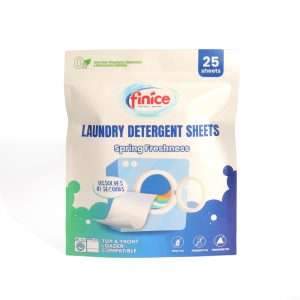
Finice supplies laundry detergent sheets and other household cleaning formats for international B2B customers, including private label brands, retailers, distributors and importers. Buyers can review the laundry detergent sheets manufacturer page for product and customization information, then contact the team through the Contact Us page with target market, pack size, fragrance direction, expected volume and preferred delivery terms.
For a more complete quotation, send a structured RFQ that includes:
- Destination country and delivery location
- Target retail positioning
- Estimated first order and annual volume
- Preferred pack count and number of loads
- Fragrance or fragrance-free requirements
- Packaging format and private label artwork status
- Required documents and target launch date
FAQ
What is the difference between FOB and CIF for laundry detergent sheets?
FOB generally covers the product and delivery to the named origin port, while CIF adds ocean freight and insurance to the destination port. The exact responsibilities depend on the agreed Incoterm and should be confirmed in writing.
Should I compare cost per kilogram or cost per wash?
For retail and distribution decisions, cost per wash is usually more useful because it reflects the number of loads and the recommended dosage. Cost per kilogram can still help compare material efficiency, but it should not be the only metric.
What information should I provide for a realistic quotation?
Provide the target market, delivery point, pack specification, expected order quantity, packaging format, formula direction, required documents and preferred Incoterm. More complete inputs produce more comparable quotations.
Can a lower MOQ reduce my total landed cost?
It can reduce inventory and working-capital pressure, but a smaller order may have a higher unit price or less efficient freight. The right decision depends on sell-through, cash flow and replenishment timing.
Conclusion
Landed cost gives B2B buyers a more realistic view of what a laundry detergent sheets program will cost after it reaches the warehouse. By normalizing the quotation basis, checking packaging and freight efficiency, confirming import obligations and evaluating MOQ alongside supplier capability, importers and retailers can make better sourcing decisions.
For a private label, wholesale or OEM project, contact Finice with your target market and product requirements to request a structured quotation based on your intended pack format and order volume.