For brands, retailers, distributors, and e-commerce sellers, choosing a private label laundry detergent sheet manufacturer is not simply a matter of finding the lowest factory price. The right supplier must balance cleaning performance, sheet quality, water solubility, fragrance options, packaging flexibility, quality control, compliance support, production capacity, and reliable export service.
That matters even more as laundry detergent sheets move from a niche format toward a broader household-cleaning category. Buyers are looking for compact, convenient and lower-waste formats, while brands need a manufacturing partner that can turn a product concept into a commercially reliable private-label SKU.
This guide explains the key points B2B buyers should evaluate before selecting a laundry detergent sheet manufacturer and how to compare suppliers beyond the quotation sheet.
Why Manufacturer Selection Matters for Private Label Laundry Sheets
A laundry detergent sheet may look simple, but its commercial performance depends on several connected factors: formulation, active-ingredient distribution, film formation, moisture control, cutting accuracy, packaging, storage conditions, and production consistency.
A supplier that can produce attractive samples is not automatically a suitable long-term manufacturing partner. B2B buyers should evaluate whether the manufacturer can reproduce the same product quality at scale and support the documentation and packaging requirements of the target market.
For private-label brands, the manufacturer also becomes part of the supply chain behind the customer experience. Inconsistent dissolution, weak cleaning performance, damaged packaging, or unstable fragrance can quickly create returns and negative reviews.
1. Evaluate Laundry Detergent Sheet Quality
Start with the finished sheet rather than the supplier’s marketing claims. Request representative samples and evaluate them under controlled, repeatable conditions.
Key quality points
- Sheet uniformity: Thickness, size, texture, and appearance should be consistent across samples.
- Handling: Sheets should be practical to separate and dose without excessive sticking or tearing.
- Cleaning performance: Test realistic loads and common stains relevant to your target market.
- Fragrance: If scented, evaluate both the dry-sheet aroma and the fragrance remaining after washing.
- Storage stability: Packaging should protect the sheets from moisture and environmental exposure.
Do not judge a supplier from one sample alone. Ask for samples from different production batches when possible. Consistency is one of the most important indicators of manufacturing maturity.
2. Check Formulation and Customization Capability
Private label means more than printing your logo on an existing product. Depending on your business model, you may need adjustments to fragrance, cleaning profile, sheet size, concentration, packaging format, or product positioning.
Ask the manufacturer what can actually be customized. A capable supplier should be able to explain the practical boundaries of formulation changes instead of simply promising that everything is possible.
Useful customization questions
- Can the formula be adjusted for different cleaning or fragrance preferences?
- Can fragrance levels and fragrance types be customized?
- Are different sheet sizes or dosing formats available?
- Can the manufacturer support fragrance-free or sensitive-skin-oriented product concepts where technically appropriate?
- Can packaging be developed for different retail channels?
- Can the supplier support OEM as well as private-label projects?
For brands entering a new market, formulation discussions should also consider local product requirements and the documentation needed for import and sale.
3. Test Water Solubility and Washing Performance
Water solubility is one of the defining characteristics of detergent sheets. Buyers should test it rather than relying only on a specification sheet.
Run samples in different water temperatures and washing conditions relevant to your target market. Observe how quickly the sheet disperses, whether residue remains, and whether the product performs consistently in normal and larger loads.
For international B2B purchasing, it is useful to test more than one machine type and water condition when practical. A product that performs well in one controlled test may need further validation before being launched across several countries.
4. Review Private Label Packaging Options
Packaging is both a branding tool and a product-protection system. Laundry detergent sheets are sensitive to moisture, so packaging design should protect the product during manufacturing, storage, shipping, and retail handling.
Ask the manufacturer about available packaging formats such as paper-based boxes, pouches, cartons, inserts, and other retail-ready configurations. Discuss dimensions, printing, materials, closures, moisture protection, barcodes, labeling requirements, and carton packing before approving the final artwork.
It is also important to confirm whether the factory can coordinate packaging procurement and assembly. A supplier that manages more of the production chain can simplify communication and reduce the number of separate vendors involved in a launch.
5. Verify Quality Control and Compliance Support
For B2B buyers, quality control should be discussed before placing a large order. Ask how incoming materials, production batches, finished products, and packaging are inspected.
You should also identify which product documents the supplier can provide and which documents need to come from an independent laboratory or other qualified organization. Requirements vary by market and product claims, so a responsible manufacturer should not promise certifications or regulatory approval without appropriate evidence.
A practical supplier documentation checklist
- Product specification and ingredient-related documentation where applicable
- Batch or quality-control records where available
- Packaging specifications and artwork review support
- Relevant test reports from qualified laboratories when required
- Shipping and export documentation
- Market-specific compliance support within the manufacturer’s actual capabilities
6. Assess Production Capacity and Lead Time
A supplier may provide an attractive sample and quotation but still struggle when your order volume increases. Before selecting a manufacturer, discuss production capacity, minimum order quantities, production scheduling, raw-material availability, packaging lead time, and expected replenishment cycles.
For retail and e-commerce brands, replenishment speed can be just as important as the first shipment. A manufacturer should be able to explain how it handles repeat orders and how production planning changes during peak periods.
Do not evaluate lead time as a single number. Break it into formulation approval, artwork approval, packaging procurement, production, inspection, and shipment preparation. This gives you a much more realistic view of the launch timeline.
7. Compare Total Purchasing Cost, Not Just Unit Price
The lowest quotation is not necessarily the lowest total cost. A B2B buyer should consider the complete landed and operational cost.
| Cost factor | What to evaluate |
|---|---|
| Product price | Cost per sheet, pack, box, or retail unit |
| Packaging | Printing, materials, tooling and assembly |
| MOQ | Whether the minimum order fits your launch budget |
| Quality control | Inspection and testing requirements |
| Shipping | Carton size, weight and logistics options |
| Rework risk | Potential costs caused by inconsistent quality or packaging errors |
| Replenishment | Ability to reorder reliably at commercial scale |
A slightly higher unit price can be commercially preferable if it comes with better consistency, better packaging support, lower defect risk, and more predictable replenishment.
8. Questions to Ask a Private Label Manufacturer
Before moving from samples to a purchase order, ask the supplier for clear answers to these questions:
- What laundry detergent sheet formats and formulas can you manufacture?
- What customization options are available for formula, fragrance, size and packaging?
- What is the MOQ for a standard private-label product?
- What is the MOQ for a customized formulation?
- How do you control moisture during production and packaging?
- How do you inspect finished batches?
- What product and quality documentation can you provide?
- What is the typical production timeline after artwork and formula approval?
- How do you handle repeat orders and capacity planning?
- Can you support export packaging and documentation for my target market?
Why Work With a Private Label Laundry Detergent Sheet Manufacturer Like Finice?
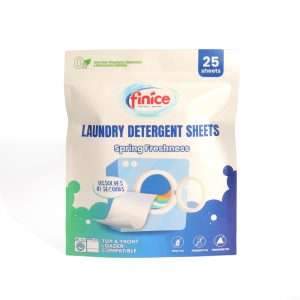
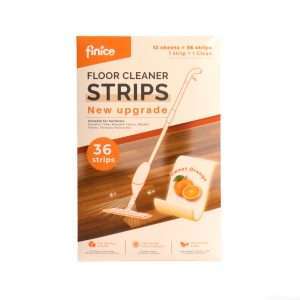
For brands looking for a B2B manufacturing partner, Finice focuses on household cleaning products including laundry detergent sheets and related laundry-care formats. Its product range also includes fragrance enhancers, dishwashing sheets, fabric softener and dryer sheets, color-absorbing sheets, wool dryer balls, pet shampoo sheets and other cleaning formats.
For a private-label project, the useful starting point is to define your target market, expected order volume, preferred product format, fragrance direction, packaging concept, required documentation, and launch timeline. These details allow a manufacturer to determine the appropriate development and production route instead of quoting a generic product without understanding the commercial application.
If you are sourcing laundry detergent sheets for a supermarket, retail chain, distributor, e-commerce brand, or private-label cleaning brand, contact Finice to discuss product selection, OEM/ODM development, packaging customization and bulk production requirements.
FAQ
What is a private label laundry detergent sheet?
A private label laundry detergent sheet is a pre-formulated or customized detergent-sheet product manufactured by a supplier and sold under the buyer’s own brand and packaging.
How should I compare two laundry detergent sheet manufacturers?
Compare product performance, consistency, customization capability, MOQ, packaging, quality control, documentation, production capacity, lead time and total purchasing cost rather than unit price alone.
What should I test before placing a bulk order?
Test dissolution, cleaning performance, fragrance if applicable, sheet consistency, packaging protection and storage stability. For commercial launches, consider independent testing appropriate to your target market and claims.
Can laundry detergent sheets be customized for different markets?
Yes, customization can potentially cover formulation, fragrance, dosage, sheet dimensions, packaging and labeling, subject to technical feasibility and applicable market requirements.
Conclusion
Selecting a private label laundry detergent sheet manufacturer is a supply-chain decision, not simply a price comparison. The strongest supplier is one that can consistently deliver the required product quality, support realistic customization, protect the sheets during storage and shipping, provide appropriate documentation, and scale with your business.
For B2B buyers, the best approach is to begin with clear specifications and samples, validate performance, review manufacturing and quality-control processes, confirm packaging and compliance requirements, and then move to a controlled commercial order.