For retailers, importers, distributors and cleaning-product brands, choosing a laundry detergent sheets OEM supplier is a strategic sourcing decision—not simply a price comparison. The right partner must help you launch a product that performs consistently, fits your market, meets documentation requirements and can scale from a first order to repeat production.

Recent industry coverage shows that laundry detergent sheets continue to attract attention because they combine pre-measured dosing, compact logistics and a sustainability-oriented format. At the same time, new product launches and B2B sourcing activity are increasing, which means buyers need a more disciplined supplier-evaluation process. GlobalData highlights continued format innovation, while Alibaba’s 2026 buyer guidance emphasizes certification, ingredient transparency and supplier verification as key differentiators. Alibaba.com
What a Laundry Detergent Sheets OEM Supplier Should Provide
An OEM supplier manufactures a product under your brand according to agreed specifications. In practice, a qualified partner should support more than production alone. You should expect a combination of formulation development, packaging coordination, quality control, documentation, export support and communication throughout the project.
For private label buyers, the supplier should be able to explain clearly:
- Which stock formulas are available and what can be customized
- Which fragrance, color, enzyme and performance options are possible
- What packaging formats and materials can be supplied
- How minimum order quantities are calculated
- What testing and quality records are available
- What markets the documentation can support
- How samples, approval, production and shipment are managed
1. Check Formula Performance Before Discussing Large Volumes
A professional-looking package cannot compensate for weak cleaning performance. Your first screening step should be a structured sample evaluation using the same conditions that matter in your target market.
Key performance checks
- Dissolution in cold and warm water
- Stain-removal performance on representative household soils
- Residue after the wash cycle
- Foam level and compatibility with common washing machines
- Fragrance strength and fragrance persistence, where applicable
- Sheet thickness, tearing behavior and dose consistency
- Stability after storage and transport simulation
Ask the supplier to document the recommended dosage and test conditions. A sample that performs well only under ideal conditions may create complaints after launch. You should also compare sample batches rather than relying on one hand-selected sample.
2. Review OEM and ODM Customization Capability
Not every supplier offering “private label” can support meaningful product development. Some only print a logo on existing packaging. That may be sufficient for a quick market test, but established retailers and brands usually need more control.
A stronger OEM/ODM partner can help you develop:
- Standard, concentrated or premium cleaning formulas
- Fragrance-led, fragrance-free or sensitive-skin directions
- Different sheet sizes, dosage levels and load counts
- Retail cartons, pouches, refill packs and bulk formats
- Custom colors, scent profiles and product positioning
- Packaging copy and market-specific label information
Ask which changes require a new development project and which can be made within an existing formula platform. This distinction affects lead time, cost and MOQ.
3. Verify Quality-Control Procedures and Batch Consistency
For B2B buyers, repeatability is as important as the first sample. A supplier should be able to explain how raw materials are checked, how production parameters are controlled and how finished goods are released.
Questions to ask the factory
- How are incoming raw materials inspected?
- Which in-process checks are completed during sheet production?
- How is active content or formula consistency verified?
- How are sheet weight, dimensions and moisture controlled?
- Are retained samples kept for each production batch?
- Can the supplier provide a certificate of analysis or equivalent batch documentation?
- What happens if a batch fails inspection?
Finice’s own product and factory content emphasizes testing areas such as efficacy, active content, pH, stability and solubility. Buyers should request the actual records relevant to the selected formula and define acceptance criteria before production begins.
4. Confirm Documentation for Your Target Market
Regulatory and commercial documentation should be reviewed before you place a purchase order. Requirements vary by destination market, product claims, ingredients, packaging and sales channel.
Depending on the project, buyers may need:
- Safety Data Sheet (SDS)
- Ingredient or composition information
- Product specifications
- Microbiological or stability test results where applicable
- Third-party laboratory reports
- Allergen or fragrance information
- Packaging and labeling support
- Social-compliance or factory-audit documents requested by a retailer
Do not assume that a document used in one country automatically satisfies another. A capable supplier should explain what is already available, what can be updated and what must be arranged by the importer or brand owner.
5. Compare MOQ, Lead Time and Scale-Up Potential
Minimum order quantity is one of the most important commercial terms, but the lowest MOQ is not always the best value. A very low MOQ may come with higher unit costs, limited customization or less stable supply.
| Area | What to clarify |
|---|---|
| Formula MOQ | Is the minimum based on kilograms, sheets, cartons or production batches? |
| Packaging MOQ | What is the minimum for custom boxes, pouches, labels or printed film? |
| Sample lead time | How long for stock samples and customized samples? |
| Production lead time | What is the realistic timeline after artwork and formula approval? |
| Repeat-order lead time | Can the supplier reserve materials or production capacity? |
| Scale-up | Can the factory support larger volumes without changing the formula or finish? |
Use a total landed-cost view. Freight, packaging, testing, customs, warehousing and inventory risk can matter more than the quoted ex-factory price.
6. Evaluate Packaging and Retail Readiness
Laundry detergent sheets are often sold through supermarkets, e-commerce, specialty retail and subscription channels. Packaging must protect the sheets, communicate the dose clearly and fit your shelf or fulfillment model.
Review the supplier’s ability to support:
- Moisture-resistant protection where needed
- Clear load-count and dosage communication
- Barcode, carton and pallet requirements
- Retail-ready artwork and compliant label content
- Compact formats for e-commerce and travel
- Private-label consistency across a product range
Ask for a packaging proof or pre-production sample. Small issues such as weak seals, unclear dosage instructions or inconsistent print color can become expensive after mass production.
7. Assess Communication, Ownership and Problem Solving
A supplier can have good equipment and still be difficult to work with. During the sample stage, observe how quickly the team answers questions, whether technical details are precise and whether changes are recorded accurately.
Strong warning signs include:
- Unclear answers about ingredients or test conditions
- Promises of certifications without documents
- Repeated changes to MOQ or lead time
- No defined sample-approval process
- Reluctance to explain defects or corrective action
- Pressure to place a large order before validation
For international buyers, a reliable communication process reduces the risk of misunderstandings across formula, artwork, packing and shipping.
8. Use a Practical Supplier-Comparison Scorecard
Instead of comparing factories based on one quotation, create a weighted scorecard. This makes your decision easier to explain internally and helps prevent a low price from hiding operational risk.
| Category | Suggested weight |
|---|---|
| Cleaning and dissolution performance | 25% |
| Quality control and batch consistency | 20% |
| OEM/ODM flexibility | 15% |
| Documentation and market support | 15% |
| MOQ, price and landed cost | 10% |
| Lead time and capacity | 10% |
| Communication and service | 5% |
You can adjust the weights based on your business model. A supermarket chain may place more weight on audit readiness and packaging compliance, while a startup brand may prioritize low-risk pilot orders and flexible customization.
Questions to Ask Before You Approve a Supplier
- What is the recommended dose per wash and how is it validated?
- Which formulas are suitable for cold-water washing?
- What customization is possible without creating a completely new formula?
- What testing and batch documents will be supplied?
- What are the formula and packaging MOQs?
- What is the sample-to-production timeline?
- How are artwork approval and change control managed?
- What is the process for handling quality claims?
- Can you support repeat orders and higher volume later?
- Which export and destination-market documents can you provide?
Why Work With Finice for Private Label Laundry Detergent Sheets?
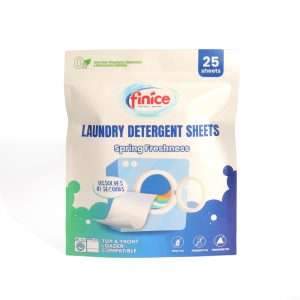
Finice supports B2B buyers looking for laundry detergent sheets, fragrance enhancers, fabric care products and other compact household-cleaning formats. For private-label and wholesale projects, the practical value is the ability to connect product development, packaging, quality control and export coordination in one sourcing process.
Explore Finice’s laundry detergent sheets manufacturing capabilities, review related laundry and fabric care products, or contact the team to discuss OEM, ODM and private-label requirements.
FAQ
What is the difference between OEM and ODM laundry detergent sheets?
OEM usually means producing to your brand and agreed specifications, while ODM often includes more support with formula development, product structure or packaging solutions. Many suppliers offer both, but the exact scope should be confirmed in writing.
How many samples should a B2B buyer test?
At minimum, test more than one batch or production sample and use the same wash conditions across suppliers. Larger retail projects should also evaluate packaging durability and storage stability.
Is the lowest MOQ always the best option?
No. A low MOQ can be useful for market testing, but it may have higher unit costs or fewer customization options. Compare the full landed cost and your expected repeat-order plan.
What is the most important factor when selecting a supplier?
For most buyers, it is the combination of consistent cleaning performance, reliable quality control, suitable documentation and the ability to scale. Price matters, but it should not be evaluated in isolation.
Conclusion
Choosing a laundry detergent sheets OEM supplier requires a structured review of performance, customization, quality, documentation, packaging, MOQ, lead time and communication. The strongest supplier is not always the one with the lowest first quotation. It is the one that can help you launch a compliant, differentiated product and support reliable repeat supply.
If you are sourcing laundry detergent sheets for a private-label brand, supermarket program, distributor business or wholesale channel, send Finice your target market, product positioning, packaging concept and estimated volume. The earlier these details are defined, the faster the right OEM/ODM solution can be evaluated.