For importers, wholesalers, distributors, retailers, and private-label brands, minimum order quantity (MOQ) is one of the first questions to ask a laundry detergent sheet manufacturer. But a quoted MOQ is only useful when you understand exactly what it includes.
A manufacturer may define MOQ by sheets, retail boxes, cartons, formula batches, fragrance runs, or printed packaging. Two suppliers can therefore quote the same-looking MOQ while creating very different inventory commitments. For a growing laundry brand, understanding the difference can protect cash flow, reduce excess stock, and make supplier comparisons much more accurate.
This guide explains how to evaluate laundry detergent sheets MOQ for OEM, ODM, private label, and bulk purchasing programs—and what to ask a manufacturer before placing an order.
What Does MOQ Mean for Laundry Detergent Sheets?
MOQ means the minimum quantity a manufacturer requires for a production order. In laundry detergent sheet manufacturing, however, the number can refer to different units.
| MOQ Type | What It Means | Why It Matters |
|---|---|---|
| Sheets | Total individual detergent sheets produced | Useful for comparing production volume |
| Retail packages | Finished boxes or pouches ready for sale | Important for inventory and warehouse planning |
| Cartons | Shipping cases containing multiple retail units | Useful for freight and pallet calculations |
| Formula batch | Minimum amount of one customized formula | Can affect how many SKUs you can economically launch |
| Packaging MOQ | Minimum quantity of printed boxes, pouches, labels, or other packaging | Can become the real production constraint |
For example, 100,000 sheets could represent 2,000 retail boxes if each box contains 50 sheets. But if a supplier quotes 2,000 boxes, the actual sheet commitment depends on the sheet count per package. Always convert the quotation into all three units: total sheets, finished retail units, and shipping cartons.
Why the Lowest MOQ Is Not Always the Best Option
A low MOQ can be attractive for a new brand, but it should not be the only supplier-selection criterion. A manufacturer with a very low minimum may have limited formula customization, fewer packaging choices, or a higher unit cost.
On the other hand, a larger MOQ may make sense when you already have stable sales and want a lower production cost per unit.
- New brands: prioritize manageable inventory, samples, flexible customization, and low financial risk.
- Growing e-commerce brands: balance MOQ with sales velocity, advertising plans, and replenishment lead time.
- Retail chains: calculate store rollout quantities, promotional inventory, and safety stock before negotiating production volume.
- Distributors: evaluate MOQ against warehouse capacity and the number of customers you can serve.
- Established brands: larger runs can improve production efficiency and landed cost when demand is predictable.
How to Calculate the Right Laundry Detergent Sheets Order Size
A practical starting point is to estimate your expected monthly sales, desired inventory coverage, and supplier lead time.
Basic order planning formula:
Required order quantity = expected monthly sales × inventory coverage in months + safety stock − available inventory.
Suppose a brand expects to sell 1,500 retail boxes per month, wants two months of coverage, and keeps 500 boxes as safety stock. If 400 boxes remain in the warehouse, the planned order would be:
1,500 × 2 + 500 − 400 = 3,100 boxes.
This is only an inventory-planning example. Actual demand should be based on your historical sales, forecast, promotions, seasonality, and supplier lead time.
Step 1: Forecast demand by SKU
Do not calculate one MOQ for the entire brand if you sell multiple fragrances, formulas, package sizes, or markets. Estimate demand separately for each SKU.
Step 2: Separate core SKUs from experimental SKUs
Your best-selling fragrance or formula can usually support a larger run. New fragrances and limited-edition products should be evaluated more conservatively.
Step 3: Add realistic safety stock
Safety stock can help protect against demand spikes or production delays, but excessive safety stock ties up working capital. Your target should reflect actual supply-chain risk rather than an arbitrary percentage.
Step 4: Check the manufacturer’s lead time
A small MOQ does not help much if the production schedule is unpredictable. Ask for both the standard lead time and the expected lead time for your specific formula and packaging configuration.
What Can Increase the MOQ for Private Label Laundry Sheets?
Private-label orders often involve more than the detergent sheet itself. Several customization decisions can create separate minimums.
| Customization | Potential MOQ Impact |
|---|---|
| Custom formula | May require a dedicated formulation or production batch |
| Custom fragrance | May require fragrance development and a separate production run |
| Custom sheet color or shape | May require additional setup and production controls |
| Printed packaging | Packaging suppliers may impose their own print minimum |
| Multiple languages | Separate artwork versions can increase packaging complexity |
| Small package counts | Can change the number of finished units produced from one sheet run |
This is why buyers should ask a manufacturer to provide a SKU-level MOQ breakdown, rather than simply asking, “What is your MOQ?”
Questions to Ask a Laundry Detergent Sheet Manufacturer
- Is the MOQ calculated by sheets, boxes, cartons, or production batches?
- Does the MOQ apply separately to each formula?
- Does each fragrance require a separate MOQ?
- Does each packaging design have a separate printing minimum?
- Can multiple fragrances share one production run?
- Can standard formulas be ordered at a lower MOQ than custom formulas?
- What is the sample-to-production process?
- What is the standard lead time after artwork and formula approval?
- What happens if packaging is ordered above the finished-product quantity?
- Can unused printed packaging be stored for the next production run?
- What quality-control tests are performed before shipment?
- Can the manufacturer provide product specifications, SDS, COA, and applicable test reports?
MOQ vs. Unit Cost: Which Should B2B Buyers Prioritize?
The correct comparison is not simply “Supplier A has a lower MOQ.” You should compare the landed cost per sellable retail unit.
| Cost Factor | What to Compare |
|---|---|
| Product cost | Price per sheet or retail package |
| Packaging | Box, pouch, label, printing, and inserts |
| Sampling | Customized samples and development costs |
| Testing | Product, stability, safety, or market-specific testing |
| Freight | Ocean, air, courier, and local delivery |
| Import costs | Duties, taxes, customs, and brokerage where applicable |
| Inventory carrying cost | Warehouse space and capital tied up in stock |
A slightly higher unit price with a manageable MOQ can sometimes be financially better than a lower unit price attached to a much larger order.
How MOQ Should Fit Different B2B Business Models
Private-label startups
Start with a focused SKU strategy. One or two strong products can be easier to test than launching many fragrances and package sizes at once. Ask manufacturers whether standard formulas and packaging can reduce the initial commitment.
Amazon and e-commerce sellers
Use historical conversion and sales data to build a replenishment model. Pay attention to warehouse storage costs and the time required to manufacture and ship the next batch.
Supermarkets and retail chains
Retail programs may require significantly more inventory because of store count, initial shelf fill, promotions, and distribution-center requirements. Confirm the exact case pack and pallet configuration before finalizing the order.
Importers and distributors
Calculate MOQ against your customer portfolio rather than one account. A flexible manufacturer can sometimes help distributors consolidate demand across several customers or product variations, depending on the production setup.
How Finice Supports Private Label Laundry Sheet Programs
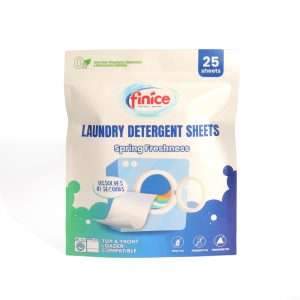
Finice manufactures laundry detergent sheets and other household cleaning products for international B2B buyers, with OEM/ODM and private-label services. The company provides customized formulas, fragrances, packaging, samples, and export support for buyers developing or expanding cleaning-product lines.
When discussing a project with a manufacturer, the most useful information to prepare is your target market, estimated monthly volume, preferred sheet count per package, fragrance direction, formula requirements, packaging concept, and target launch date. This allows the factory to evaluate the right production configuration instead of giving you a generic MOQ. You can also review Finice’s laundry detergent sheet product range when comparing available product formats and customization directions.
For buyers comparing suppliers, Finice’s private label laundry detergent sheet manufacturer guide provides a broader framework for evaluating quality, customization, packaging, compliance, and production capabilities.
Frequently Asked Questions
What is a typical MOQ for private label laundry detergent sheets?
There is no single industry-wide MOQ. It can vary by manufacturer, formula, fragrance, package type, sheet count, and printing requirements. Ask for the MOQ in sheets and finished retail units.
Can I get a lower MOQ for standard laundry detergent sheets?
Often, standard products can be easier to produce at lower quantities because they use an existing formula and packaging configuration. Confirm the manufacturer’s current terms before ordering.
Does custom packaging increase MOQ?
It can. Printed packaging may have its own minimum production quantity, and the packaging MOQ can become higher than the detergent sheet MOQ.
Should a new laundry brand order the maximum MOQ?
Not automatically. The right quantity should match realistic demand, cash flow, lead time, storage capacity, and the number of SKUs you plan to sell.
What should I include in an RFQ to get an accurate MOQ?
Include target market, formula type, fragrance, sheet dimensions if known, sheets per package, packaging format, estimated order volume, artwork requirements, and desired delivery schedule. The more complete the brief, the more useful the quotation will be.
Conclusion
MOQ is not just a number on a supplier quotation. For laundry detergent sheets, it is connected to formula development, fragrance selection, packaging, production efficiency, inventory risk, and landed cost.
The best B2B purchasing decision is to compare suppliers using the same units and the same assumptions. Convert MOQ into sheets, retail packages, and cartons; calculate expected demand by SKU; identify packaging and formula minimums; and evaluate the total landed cost.
If you are sourcing laundry detergent sheets for a private-label, wholesale, retail, or distribution program, contact Finice with your target market, estimated volume, packaging requirements, and product concept to discuss a suitable OEM/ODM solution.