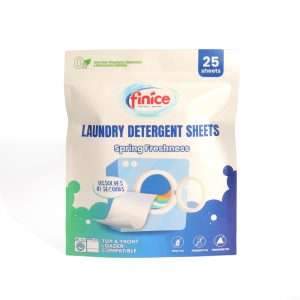
A laundry sheet pack can contain a stated number of sheets without providing the same number of washes in every situation. Confusion often starts when a full sheet, a perforated section and a recommended dose are treated as interchangeable units.
For private label buyers, agreeing those definitions before artwork approval helps prevent inconsistent quotations, confusing product listings and avoidable customer questions. This guide provides a practical review process rather than a universal dose recommendation.

Define the physical unit in the specification
Describe a full sheet by its agreed dimensions and product reference. If it has perforations, state how many sections it contains and how they are intended to be separated. Add a drawing or photograph so the word “sheet” cannot refer to two different things.
Ask the supplier to use the same definition in the quotation, sample label, production specification and carton artwork. A quote for full sheets cannot be compared directly with a quote for smaller sections merely because both use the word “piece.”
Keep three quantities separate
| Quantity | Meaning | Approval question |
|---|---|---|
| Physical sheet count | Full sheets supplied in the pack | How is each full sheet defined and counted? |
| Usable section count | Portions formed by the intended perforations | Can users separate the sections as directed? |
| Stated wash count | Uses calculated from an identified dose scenario | What load and dosing assumptions support the statement? |
For illustration only, a pack with 30 full sheets divided into two sections per sheet contains 60 sections. That does not automatically establish 60 washes. The answer depends on whether the validated dose for the stated conditions is one section, one full sheet or another amount.
Connect wash-count wording to supported directions
Request the intended dosing guide for the exact formula. Review the relevant load size, soil level, water conditions and washing method. Do not use the lowest imaginable dose simply to create a larger number on the front of the pack.
Check that any qualifying wording is understandable alongside the claim. The online listing should preserve the same meaning as the carton. A marketplace title promising one wash count while the back-panel instructions imply another is a sign that the specification needs another review.
Test perforation usability with representative samples
Ask an unfamiliar user to separate the intended portion according to the proposed instructions. Record whether the tear follows the perforation and whether users can identify a full sheet versus a section. Check several packs rather than relying on one demonstration sample.
Assess the same handling after representative packaged storage, using agreed conditions. A portion that separates easily at initial approval should also be evaluated after storage relevant to the sales route. Our laundry sheet packaging checklist explains how to organize the pack-protection part of that review.
Review the artwork from a customer’s perspective
Place the pack, a loose full sheet and a separated section together. Ask someone outside the project to show how much they would use for the scenario described on the label. If their interpretation differs from the technical brief, revise the wording or image.
Do not rely on color alone to distinguish doses. Use clear drawings, consistent units and legible text. Review translated versions against the same physical sample so a fluent translation does not silently change a full sheet into a half sheet.
Include count and portion checks in production approval
- Agreed full-sheet dimensions and product version.
- Perforation drawing and expected section count.
- Full sheets per retail pack and packs per shipping case.
- Written dosing guide and the assumptions behind stated uses.
- Method for checking counts and handling defects.
- Approved artwork, listing copy and retained sample.
- Change-notification requirements for size, mass or perforation.
Define acceptance criteria and the inspection approach before the production lot is assessed. If a discrepancy is found, record whether it concerns missing sheets, a counting-definition mismatch or difficult portion separation; those are different problems with different remedies.
Request a sample with the proposed label
Explore Finice laundry sheet manufacturing options and send your pack-count and dosing requirements. Request the physical sample and proposed directions together so your team can approve the complete consumer experience.
Should importers compare price per sheet or price per wash?
Use clearly defined units for both. Price per full sheet helps compare the supplied format; cost per intended wash also requires an evidence-supported dose. Neither comparison is meaningful when suppliers count different units.